 Publish DDD File (not available with the Free Viewer and EXE files)
Publish all loaded 3D models and 2D drawings as a 3D-Tool DDD file. DDD files can be opened and viewed with the 3D-Tool Free Viewer on any computer with a Windows operating system.
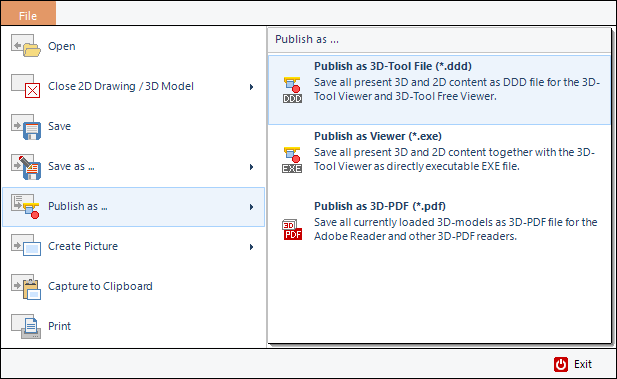
To publish an DDD file open the FILE tab, go to  Publish as … and select Publish as 3D-Tool File (*.ddd); or click on in the Quick Access Toolbar and set the file type to *.ddd.
 Settings When Publishing a DDD File
Options When Publishing a DDD File
Characteristics of DDD files
3D-Tool DDD files contain:
- The 3D models including PMI, 3Ddimensions/markups and materials.
- The 2D drawings including 2D redline markups and 2D-dimensions.
- Custom Views and animations.
The DDD files can be passed on by e-mail or data carrier. The recipient can view the DDD files with the 3D-Tool Free Viewer.
The Free Viewer can be downloaded free of charge from www.3D-Tool.com.
 Note
Note
3D-Tool EXE and DDD files published by a certain major version of 3D-Tool can only be opened by 3D-Tool or the 3D-Tool FreeViewer in this or a newer major version.
Settings When Publishing a DDD File
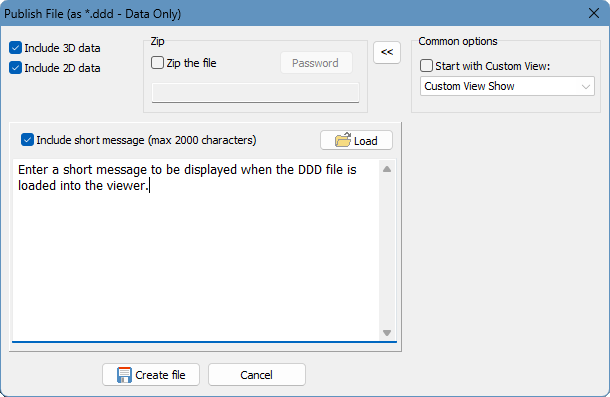
Include 3D data
Publish all currently loaded 3D-models.
Include 2D data
Publish all currently loaded 2D-drawings.
ZIP the file
Create the DDD file and pack it into a ZIP archive (*.zip).
Password
Enter a password to protect a ZIP archive against unauthorized use.
Include short message
Enter a message of up to 2000 characters that will appear at the start-up of the DDD file. Use  Load to load a text file (*.txt) as a message.
Note
Unzipping password protected 3D-Tool ZIP archives requires archive software supporting the AES 256 encryption standard. The default Windows ZIP feature does not support this encryption, so that third party software is required.
Options When Publishing a DDD File
Options
Click the [>>] button to make further adjustments.
- Start with: Start the DDD file with a Custom View Show, a certain Custom View or animation.
- 3D - Shade mode: Designate the shade mode of the models on start-up.
- 3D - Back faces: Designate the display mode of the back faces on start-up.